

by Dr Tahaney Alghrani
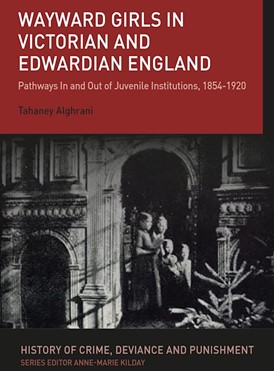
In this blog, I will be delving into one of the key themes from my recently published book Wayward Girls (2024), which I recently presented at the AHRC Care or Criminality workshop in Manchester (June, 2024). This discussion centres on the historical pathways that led young girls into the juvenile estate in the nineteenth century, focusing on the complex, overlapping themes of care and criminality. It will firstly present a brief timeline of the reformatory and Industrial schools Acts. Secondly it will present the methods and sources utilised for this research before highlighting the pathways.
Establishment of the Reformatory and Industrial Schools
The 1854 Reformatory Schools Act and the 1857 Industrial School Act, along with subsequent Amendment Acts, outlined the specific circumstances in which a child could be committed to these institutions. Reformatories were designated for children who had committed a criminal offence, whereas Industrial Schools were intended for those deemed ‘at risk’ of falling into criminality. However, between 1861 and 1880, the industrial schools’ Amendment Acts expanded the categories of children eligible for admission, further blurring the lines between the reformatory and Industrial schools. Juvenile girls, in particular, were often caught in this ambiguous space. As Pasko (2010) articulates, these girls were portrayed as both victims and ‘sexualised demons,’ posing a danger not only to themselves but also to society at large (Pasko, 2010: 1102). This dual perception fuelled the desire to ‘save’ these girls and prevent their descent into immorality, thereby further complicating the already tenuous distinction between criminality and care established for juvenile girls. (Mahood, 1994: Cox, 2013).The historical treatment of these girls raises important questions about how society defined and responded to youthful transgressions. By examining these themes, Wayward Girls offers a critical lens on the ways in which the boundaries between care and criminality have been negotiated, blurred, and enforced over time.

Liverpool Industrial School, Kirkdale, 1850: Illustrated London News, via Getty Images.
Method and Sources
This research employs a record linkage methodology to examine the pathways and immediate post-discharge period for a core sample of 465 girls who entered the institutions between 1854 and 1900. To gain a broader perspective on their experiences after leaving these institutions, I also analysed a larger sample of discharge records covering the period up to 1920. This extended analysis allows for a comprehensive understanding of the girls’ experiences during the license period following their departure from the institutions.
The principal source for this research includes the admission and discharge records of the girls who were placed in the three juvenile institutions under study. In addition to these, I consulted various institutional records such as annual report books, minute books, letters, medical books, visitor books and the private diary of the superintendent of Red Lodge, Mary Carpenter. These sources provide original and invaluable insights into the lives and experiences of the girls, as well as the operations and decisions of the institutions that shaped their trajectories. However, these must be used with a critical eye to avoid institutional bias, acknowledging the social and cultural contexts in which they were recorded. To enhance the accuracy and depth of the study, I also cross-checked the institutions and the girls who entered them with the historical newspapers and census records using Find My Past and Ancestry. Additionally, the study draws on digitised historical records, such as Home Office Reports on the institutions within the UK Parliamentary Papers database. This multi-source approach ensures a robust and well-rounded understanding of the pathways and experiences of the girls during and after their time in these institutions.
Leading research undertaken on juvenile boys Young Criminal Lives by Godfrey et al. (2017) used both archival and digital sources to examine the lives of juveniles in the nineteenth century and trace their destinations after release utilising the life course methodology tracing 500 boys who entered the institutions to investigate the extent to which these interventions ‘worked’ in terms of assessing their life course and whether they persisted or desisted from a ‘life of crime’. Similarly, Lucy Williams, in her unpublished PhD, “At Large”: Women’s Lives and Offending in Victorian Liverpool and London (2014), examined the lives of offending women but acknowledged that she was compelled to work with the sources available, which did not in every instance provide the ‘cradle to grave’ information that was needed to apply a life course methodology. Attempting to trace young females throughout their life course is made virtually impossible mainly because the girls changed their name on marriage. Cox et al. (2019) maintain that the similarities between the names and ages amongst the female cohort in a reform institution means that identifying specific girls is difficult. The difficulties associated with name changes in terms of locating sources of information with reference to specific girls, has undermined attempts to capture the female experience within crime history and resulted in its marginalisation Wayward Girls offers crucial micro-histories of the experiences of the girls who passed through the juvenile institutions in the nineteenth and twentieth century.

Farmfield Reformatory For Female Inebriates, Charlwood Road, Horley, Surrey, 1910. Image via Getty Images.
Pathways into the Institutions
The examination of the pathways revealed that girls were overwhelmingly admitted to Manchester Sale and Carlton Industrial School for status offences, such as wandering, loitering, truancy and being in ‘want of proper guardianship’. The majority of those admitted to Red Lodge Reformatory had committed property crimes, such as theft and petty larceny, usually related to items of relatively small value. This study has highlighted how the Victorian gendered ‘ideology’ and ideal of ‘respectable femininity’ conditioned the criminal justice responses of the first carceral juvenile estate established for girls. The governance within all three institutions reflected the micro-politics of the domestic home. The institutions for females sought to replicate the gendered structure and responsibilities of the home. Gendered identities were intensely regulated and normalised through strict, regimented timetables, in which daily worship and industrial service constituted a central part of the girls’ daily routine. The institutions’ gendered ‘ideology’ of the home and private sphere was central to its structure and governance, normalising gendered identities (Cox, 2013; Barton, 2005).
Conclusion
In summary, the categorization of girls as both a ‘threat’ and a ‘victim’, ‘virtuous’ and ‘vicious’, remains evident in the penal and welfare reforms today, just as it was in the 1850s (Carlen, 1985, Goodfellow, 2019). The book highlighted how the Victorian gendered ‘ideology’ and ideal of ‘respectable femininity’ shaped the criminal justice responses of the first carceral juvenile estate established for girls. The perceived need to ‘rescue’ these girls and prevent ‘immorality’ led to the blurring of the division between criminality and care established for juvenile girls. Chesney-Lind and Sheldon (2014) argue that this blurring of the division between the penalisation and protection of juvenile girls has become embedded in the juvenile institutions for girls today. The legacy of Victorian ideals continues to influence how juvenile girls are perceived and treated within the criminal justice system, underscoring the persistent impact of historical ideologies on contemporary practices.
Further Reading
Barton, A. (2005) Fragile Moralities and Dangerous Sexualities: Two centuries of Semi Penal Institutionalisation for Women,Aldershot, Ashgate.
Barton, A. (2011) A Woman’s Place: Uncovering Maternalistic Forms of Governance in the 19th Century Reformation, Family and Community History, vol. 14, pp. 89-104.
Carlen, P. (1988) Women, Crime and Poverty, Milton Keynes: Open University Press.
Carlen, P. (2002) Women and Punishment: The Struggle for Justice. Collumpton: Willan.
Cox, P. (2013) Bad Girls in Britain, Gender, Justice and Welfare 1900-1950, Basingstoke, Palgrave Macmillan.
Cox, P., Shore, H., Godfrey, B., and Alker, Z. (2019) Tracking the Gendered Life Courses of Care Leavers in 19th-Century Britain, Longitudinal and Life Course Studies 2019, vol 9 Issue 1, pp. 115–128.
Chesney-Lind, M. (1989) Girls’ crime and woman’s place: Toward a feminist model of female delinquency. Crime and Delinquency 35, pp. 5-30.
Chesney-Lind, M. (1997) The Female Offender: Girls, Women and Crime, Thousand Oaks, California, Sage.
Chesney-Lind, M and Pasko, L. (2013) The Female Offender: Girls, Women and Crime (3rd ed), Thousand Oaks, CA: Sage
Daly, K and Chesney-Lind, M. (1988) ‘Feminism and Criminology’, Justice Quarterly 5(4): pp. 101-43.
Daly, K. (1992) ‘Women’s Pathways to Felony Court: Feminist Theories of Lawbreaking and Problems of Representation’, Review of Law and Women’s Studies, vol 2, pp. 11-52.
Daly, K. (1994) Gender, Crime and Punishment New Haven and London, Yale University Press.
Goodfellow, P. (2019) Outnumbered, locked up and Overlooked? The Use of Penal Custody for girls In England and Wales, The Griffins Society, Research Paper 2017/02.
Godfrey, B., Cox, P., Shore, H., and Alker, Z. (2017) Young Criminal Lives: Life Courses and Life Chances from 1850, Oxford, Oxford University Press.
Mahood, L. (1995) Policing Gender, Class and Family, Britain 1850-1945, London, UCL Press.
Mahood, L. and Littlewood, B. (1991) Prostitutes, Magdalenes and Wayward Girls: Dangerous Sexualities of Working-Class Women in Victorian Scotland in Gender and History, vol.3 (2) pp. 160-175.
Pasko, L. (2010) Damaged Daughters: The History of Girls’ Sexuality and the Juvenile System, The Journal of Law and Criminology, vol.100, No3 pp. 1099 -1130.
Williams, L. (2014) “At Large”: Women’s Lives and Offending in Victorian Liverpool and London, University of Liverpool.
 Care or Criminality?